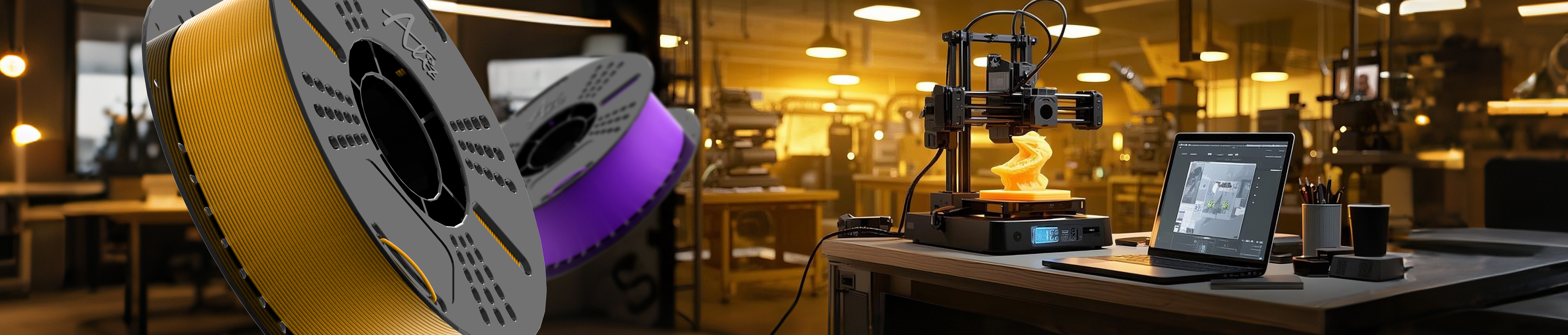
Sourcing industrial 3D printing materials from a new supplier is never simple. Buyers need consistent mechanical performance, verified specifications, and a manufacturer who can support long-term orders. This guide explains what Nylon Glass Fiber 3D Printing Filament is, how it performs, and why international importers, distributors, and OEM/ODM buyers choose Aliz, the 3D printing filament brand of Jiangyin Longshan Synthetic Material Co., Ltd.
Nylon Glass Fiber 3D Printing Filament (PA-GF) combines the toughness of nylon with the stiffness and dimensional stability of glass fiber reinforcement. It is widely used for functional prototypes, jigs, fixtures, and end-use parts that need to survive real mechanical and thermal loads. Whether you are comparing suppliers, checking technical data, or preparing your first inquiry, this article covers the specifications, applications, and buyer information you need before contacting a manufacturer.
What Is Nylon Glass Fiber 3D Printing Filament?
Nylon Glass Fiber 3D Printing Filament, often labeled
PA-GF, is an engineering-grade nylon compound reinforced with chopped glass fibers. The glass fiber content increases stiffness, dimensional stability, and heat resistance compared with unreinforced nylon, while the polyamide base keeps the material tough and impact-resistant.
Aliz's
PA-GF Industry filament is formulated for functional 3D printing applications rather than decorative prints. It produces a matte, low-gloss surface and prints without needing a heated chamber, making it accessible to a wide range of FDM 3D printers used in factories, workshops, and engineering labs.
For buyers comparing materials,
PA-GF sits between standard nylon and nylon carbon fiber (PA-CF) in terms of stiffness and surface finish, offering a balance of mechanical strength, chemical resistance, and cost efficiency for industrial parts production.

Nylon Glass Fiber (PA-GF) Filament Technical Specifications
Before placing an order, buyers usually want to confirm the basic physical specification of the filament. Aliz's
Nylon Glass Fiber Filament specification:
• Filament diameter: 1.75 mm / 2.85 mm
• Spool weight: 1 kg / 3 kg
• Color: carbon-fiber black, matte finish
• Density: 1.23 g/cm³ (ISO 1183)
• Melt flow index (MFR): 2–12 g/10 min at 275°C / 2.16 kg (ISO 1133)
• Moisture absorption: approximately 2.7% under 3D printing test conditions (ISO 62)
These values are based on standardized ISO testing methods, which makes it easier for procurement teams and engineers to cross-check the material against their own specification sheets.
Key Properties of Glass Fiber Reinforced Nylon Filament
Glass Fiber Reinforced Nylon Filament is engineered for functional, load-bearing parts. Its main properties include:
•
Enhanced chemical and heat resistance – resists oils, greases, and many industrial fluids, with a higher heat deflection temperature than standard nylon
•
Matte surface finish – reduces visible layer lines and generally needs no post-processing
•
Low warping and strong bed adhesion – supports large or complex geometries without an enclosure
•
High toughness and impact resistance – resists cracking and fracture under shock or repeated flexing
•
Room-temperature printability – prints reliably on open-frame FDM printers, without a heated chamber
These combined properties are why the material is often selected for functional prototypes and short-run end-use parts rather than purely cosmetic prints.
Nylon Glass Fiber Filament Tensile Strength & Heat Resistance
Mechanical strength and heat resistance are usually the two most important factors procurement teams check before approving a supplier. Based on internal testing (ISO 527 and ISO 75), Aliz
PA-GF filament shows the following typical values:
• Tensile strength: 79.1 ± 4 MPa (X-Y axis), 58.1 ± 4 MPa (Z axis)
• Flexural strength: 124.7 ± 5 MPa (X-Y axis), 57.1 ± 5 MPa (Z axis)
• Heat distortion temperature (0.45 MPa): 182.7°C (X-Y axis), 171.7°C (Z axis)
• Heat distortion temperature (1.8 MPa): 151.8°C (X-Y axis), 145.1°C (Z axis)
• Melting point: 219.8°C; decomposition temperature above 370°C
As with most FDM materials, strength in the X-Y plane is higher than along the Z axis, because layer adhesion is generally the weakest direction in any printed part. Buyers designing load-bearing components should account for print orientation when calculating safety margins.
PA6-GF vs PA66-GF Nylon Glass Fiber Filament: Which Should You Choose?
Nylon glass fiber filaments are generally produced from either PA6 or PA66 resin as the base polymer. Buyers often ask which one is better suited to their application:
•
PA6-GF tends to offer better impact toughness and slightly easier printability, with good chemical resistance for general industrial use.
•
PA66-GF typically provides a higher melting point and improved dimensional stability at elevated temperatures, making it suitable for parts exposed to sustained heat.
The right choice depends on the operating temperature, load conditions, and chemical exposure of the final part. If your application has a specific base-resin requirement, it's best to confirm the exact PA-GF formulation with the supplier's technical team before ordering, since resin base can affect both mechanical performance and pricing.
Nylon Glass Fiber vs Nylon Carbon Fiber Filament: Key Differences
Nylon Glass Fiber Filament is frequently compared with Nylon Carbon Fiber Filament (PA-CF) before buyers choose between the two. Both are reinforced nylon composites, but they serve different purposes:
•
Stiffness: PA-CF is generally stiffer, since carbon fiber has a higher modulus than glass fiber.
•
Surface finish: PA-GF produces a smoother matte finish, while PA-CF has a more visible fiber texture.
•
Electrical properties: glass fiber is non-conductive, so PA-GF is preferred for parts near electronics; carbon fiber is conductive and is generally avoided in those cases.
•
Cost: PA-GF is typically more cost-effective than PA-CF for equivalent order volumes.
• Wear resistance: PA-CF, such as Aliz's
PA-CF Industry filament, provides higher self-lubrication and wear resistance, useful for gears and sliding parts.
For most structural, non-electrical, cost-sensitive industrial parts, PA-GF is a practical first choice. For applications needing maximum stiffness and wear resistance, PA-CF may be the better fit.
Glass Fiber Nylon vs Standard Nylon Filament: Strength Comparison
Compared with standard, unreinforced nylon filament,
Glass Fiber Nylon offers a clear mechanical upgrade:
• Higher tensile and flexural strength due to the glass fiber reinforcement
• Improved dimensional stability, with less shrinkage and warping during and after printing
• Higher heat distortion temperature, allowing parts to hold their shape under sustained load at elevated temperatures
• Reduced flexibility, since the added stiffness comes at the cost of some elongation at break
Standard nylon remains a good option for parts that need flexibility and impact absorption, such as living hinges or snap-fit components. Glass fiber reinforced nylon is the better option when a part needs to hold tight tolerances and resist deformation under mechanical or thermal stress.
Nylon Glass Fiber Filament Specifications Table (Diameter, Density, HDT, Tensile Strength)
The table below summarizes the key specifications of Aliz's
Nylon Glass Fiber 3D Printing Filament for quick reference:
| Property |
Value |
Test Method |
| Diameter |
1.75 mm / 2.85 mm |
— |
| Spool weight |
1 kg / 3 kg |
— |
| Color |
Carbon-fiber black, matte finish |
— |
| Density |
1.23 g/cm³ |
ISO 1183 |
| Melt flow index (MFR) |
2–12 g/10 min (275°C / 2.16 kg) |
ISO 1133 |
| Tensile strength (X-Y axis) |
79.1 ± 4 MPa |
ISO 527 |
| Tensile strength (Z axis) |
58.1 ± 4 MPa |
ISO 527 |
| Flexural strength (X-Y axis) |
124.7 ± 5 MPa |
ISO 178 |
| Heat distortion temp. (0.45 MPa, X-Y) |
182.7 °C |
ISO 75 |
| Heat distortion temp. (1.8 MPa, X-Y) |
151.8 °C |
ISO 75 |
| Melting point |
219.8 °C |
DSC |
| Decomposition temperature |
> 370 °C |
TGA |
| Moisture absorption (printed) |
≈ 2.7 % |
ISO 62 |
Industrial Applications of Nylon Glass Fiber 3D Printing Filament
Nylon Glass Fiber 3D Printing Filament is widely used across manufacturing and engineering sectors, including:
• Robotics and machinery components
• Jigs, fixtures, and manufacturing tooling
• Functional prototypes for product development
• Protective housings and enclosures for equipment
• Brackets, mounts, and structural connectors
• Replacement parts for industrial machines
Because the material combines strength with dimensional stability, it is often used to replace short-run injection-molded parts, reducing tooling costs during product development or low-volume production. To see more real-world use cases across materials, buyers can review Aliz's
3D printing filament applications page.
Best Uses for Nylon Glass Fiber Filament in Automotive & Industrial Parts
In the automotive and industrial sectors specifically,
PA-GF filament is well suited to:
• Under-hood components that need heat and chemical resistance
• Custom jigs and fixtures used on production lines
• Housings for sensors, connectors, and control units
• Structural brackets that must resist vibration and mechanical stress
• Tooling and fixtures used in assembly and quality inspection
Its resistance to oils and greases, combined with a heat distortion temperature above 170°C, makes it a practical option for parts near engines, motors, or other heat-generating equipment.
Why Choose Aliz Nylon Glass Fiber Filament Manufacturer

Aliz is the 3D printing filament brand of Jiangyin Longshan Synthetic Material Co., Ltd., a company with more than 30 years of experience in modified plastics. Longshan is recognized as a National SRDI ("Specialized, Refined, Differential, Innovative") small giant enterprise in China and operates an independent CNAS-accredited laboratory for material testing.
Longshan's products and services cover Asia, Europe, and North America, serving more than 900 industrial enterprises. This background in modified plastics gives Aliz direct access to raw material formulation and quality control, rather than relying on third-party resin compounding. For B2B buyers, this means:
• Consistent batch-to-batch quality, backed by in-house material testing
• Direct manufacturer pricing without unnecessary middlemen
• Technical support from a team with modified plastics manufacturing background
• Export experience serving international importers and distributors
OEM/ODM Nylon Glass Fiber 3D Printing Filament Solutions
Many international buyers want more than a standard product; they need customization to fit their brand or application. Aliz's
OEM/ODM services program supports:
• Custom filament formulation for specific strength, heat resistance, or flexibility requirements
• Custom colors and surface finishes
• Private labeling with your own branding on spools and packaging
• Custom spool design and packaging
• Small-batch prototype production before scaling to full volume
• Technical support and training for your team or end customers
This makes it possible for brand owners, distributors, and project contractors to launch their own branded
PA-GF filament line without building manufacturing capacity of their own.
Bulk & Wholesale Nylon Glass Fiber Filament Supply
For importers, distributors, and procurement teams sourcing in volume, Aliz supplies
Nylon Glass Fiber Filament on a wholesale basis with:
• Standard spool options in 1 kg and 3 kg formats, with 1.75 mm and 2.85 mm diameters
• Consistent raw material sourcing supported by Longshan's modified plastics production
• Export documentation and shipping support for international orders
• Flexible order quantities discussed based on your target market and application
Since exact minimum order quantities, lead times, and freight terms depend on your destination and order specification, it's best to contact the sales team directly with your requirements for an accurate quotation.
Is Nylon Glass Fiber Filament Good for 3D Printing?
Yes, for functional and industrial applications,
Nylon Glass Fiber Filament is a strong choice. It offers a practical balance of strength, heat resistance, and dimensional stability without the cost or stiffness of carbon fiber composites. It performs best when used for its intended purpose — functional parts, tooling, and engineering prototypes — rather than fine-detail decorative prints, where its matte, fiber-filled surface is less suited than smooth materials like standard PLA or PETG.
How to Print Nylon Glass Fiber Filament (Settings & Tips)
Based on Aliz's recommended parameters for a 0.4 mm nozzle:
• Printing temperature: 270–300°C
• Bed temperature: 80–100°C
• Wall layers: 2 layers minimum
• Top and bottom layers: 4 layers minimum
• Cooling fan: 0–10%
• Printing speed: 30–50 mm/s
• Ambient temperature: around 25°C, no enclosure required
Practical tips for printing
Nylon Glass Fiber Filament:
• Dry the filament before printing, since nylon absorbs moisture from the air and wet filament causes poor layer adhesion and surface defects
• Use a hardened steel nozzle, since glass fiber is abrasive and will wear down standard brass nozzles over time
• Print with an all-metal hot end to handle the higher printing temperatures required for nylon-based materials
• Test small parts first to confirm bed adhesion and dimensional accuracy before running full production batches
Frequently Asked Questions
1. What is the difference between PA-GF and PA-CF filament?
PA-GF uses glass fiber reinforcement, giving a smoother matte finish and non-conductive properties, while PA-CF uses carbon fiber, which is stiffer and conductive. You can explore Aliz's
PA-CF Industry filament for comparison.
2. Does Nylon Glass Fiber Filament need a heated enclosure to print?
No. Aliz's PA-GF filament is formulated to print reliably at room temperature without an enclosure, as long as nozzle and bed temperatures stay within the recommended range.
3. Can Aliz customize Nylon Glass Fiber Filament colors or formulations?
Yes. Through Aliz's OEM/ODM program, buyers can request custom colors, formulations, spool design, and private labeling.
4. What industries commonly use Nylon Glass Fiber 3D Printing Filament?
Common industries include automotive, industrial machinery, robotics, and general engineering, where parts need strength, heat resistance, and dimensional stability.
5. Is Nylon Glass Fiber Filament stronger than standard nylon filament?
Yes, glass fiber reinforcement increases tensile and flexural strength and improves dimensional stability compared with standard nylon, though it reduces flexibility slightly.
6. How do I request samples or a quotation for bulk orders?
Buyers can
contact our team directly with their target specification, order quantity, and destination country for an accurate quotation.
Conclusion
Nylon Glass Fiber 3D Printing Filament offers a practical combination of strength, heat resistance, and dimensional stability for industrial and functional 3D printing applications. For B2B buyers comparing suppliers, checking technical specifications, and preparing a purchase decision, Aliz by Longshan provides consistent PA-GF filament quality backed by more than 30 years of modified plastics manufacturing experience, an independent CNAS laboratory, and export support for markets across North America, Europe, the Middle East, Asia-Pacific, South America, and Africa.
Whether you need standard PA-GF filament, OEM/ODM customization, or bulk wholesale supply, our team is ready to support your requirements with technical data, samples, and reliable export documentation.
Contact our team today to request a quotation, product datasheet, or filament sample for your Nylon Glass Fiber 3D Printing Filament project.