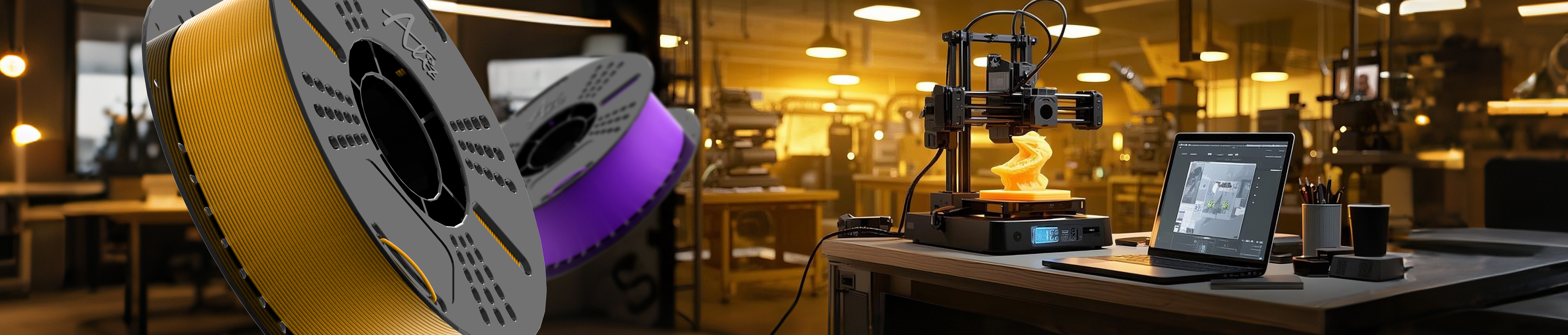
3D Printer Filament: Differences and Applications of PLA and PA Filament
3D printer filament is the foundational consumable for FDM 3D printing, serving hobbyists, design studios, educational institutions, and industrial manufacturing factories worldwide. Among dozens of mainstream thermoplastic materials, PLA 3D Printing Filament and PA 3D Printing Filament are the two most representative products, covering low-cost prototype printing and high-strength functional part manufacturing respectively. As the 3D printing industry continues to mature in 2026, users are no longer choosing filament by price alone but focusing on material adaptability, printing stability, and application matching. This article elaborates on the characteristics, printing requirements, application scenarios, and selection skills of the two core 3D printer filament types to help users make professional and accurate purchasing decisions.

1. Basic Overview of PLA 3D Printing Filament
1.1 Material Features of PLA Filament
PLA (Polylactic Acid) 3D Printing Filament is a bio-based, eco-friendly thermoplastic material refined from renewable raw materials such as corn starch and sugarcane. It is the most popular 3D printer filament in the consumer and education markets, occupying over 40% of the global filament consumption share. Unlike petroleum-based plastics, PLA filament produces almost no toxic fumes during printing, only a faint natural plant odor, making it safe for indoor, classroom, and office environments.
Standard PLA 3D Printing Filament adopts unified industrial specifications, with mainstream diameters of 1.75mm and 2.85mm and a dimensional tolerance of ±0.02mm, ensuring stable extrusion and avoiding nozzle clogging. It has an extremely low warping rate and shrinkage rate, requiring no enclosed printing chamber or high-temperature heated bed, which greatly reduces the printing threshold for beginners and ordinary desktop printer users.
1.2 Advantages and Limitations of PLA Filament
The core advantages of PLA 3D Printing Filament lie in low cost, high printing success rate, and rich presentation effects. It supports diverse surface finishes including matte, silk, and wood texture, with delicate printing details and smooth surfaces, perfectly meeting the needs of decorative models, architectural prototypes, and art creations. In addition, PLA is biodegradable under industrial composting conditions, conforming to global sustainable manufacturing and environmental protection policies.
However, PLA filament has obvious performance defects in industrial scenarios. Its heat resistance is poor, with a thermal deformation temperature of only 50-60°C. PLA parts will soften and deform in high-temperature environments such as car interiors. Meanwhile, the material is brittle, poor in impact resistance and tensile toughness, and prone to cracking under long-term stress or outdoor UV exposure, so it cannot be used for load-bearing functional mechanical parts.

2. Core Introduction of PA 3D Printing Filament
2.1 Material Properties of PA Filament
PA 3D Printing Filament, also known as nylon filament, is a high-performance engineering-grade 3D printer filament made of petroleum-based polyamide materials, mainly including PA6, PA66, and PA12 models. Different from civilian-grade PLA filament, PA filament is positioned for industrial manufacturing, with excellent mechanical strength, wear resistance, and chemical stability, and is an essential material for functional 3D printing.
PA 3D Printing Filament has outstanding self-lubricating properties and tensile ductility, which can adapt to long-term cyclic operation of mechanical parts. It is resistant to oil, lubricants, and weak acid and alkali corrosion, and has a high heat resistance temperature of 110-120°C, which can stably adapt to complex industrial working conditions. Modified PA filaments such as carbon fiber-filled and glass fiber-reinforced PA further enhance rigidity and durability, widely used in high-precision industrial fields.
2.2 Printing and Storage Requirements of PA Filament
PA 3D Printing Filament has stricter printing requirements than PLA filament. It needs a nozzle temperature of 250-270°C and a heating bed temperature of 60-100°C, and must be printed in a fully enclosed printer chamber to avoid warping and layer separation caused by high shrinkage. The biggest pain point of PA filament is strong hygroscopicity; it easily absorbs moisture in the air, resulting in bubbling, wire drawing, and rough surfaces during printing. It must be dried at 70°C for 4-8 hours before use.
In terms of storage, unsealed PA 3D Printing Filament needs to be placed in a constant humidity drying box with humidity controlled below 20%, while unused spools must be stored in vacuum sealed bags with desiccants to maintain printing stability for a long time.

3. Application Scenarios of Two Mainstream 3D Printer Filament
3.1 Application of PLA 3D Printing Filament
PLA 3D Printing Filament is mainly used in civilian and lightweight creative fields. First, it is the preferred material for school education and maker training, used to print teaching aids, anatomical models, architectural sand tables, and experimental demonstration parts, relying on its safety and low failure rate. Second, design studios and individual creators use colorful PLA filament to produce decorative crafts, toy prototypes, jewelry models, and packaging mockups, realizing rapid design iteration with low cost. In addition, PLA filament is suitable for printing indoor lightweight auxiliary parts such as cable fixers and storage brackets for short-term use.
3.2 Application of PA 3D Printing Filament
PA 3D Printing Filament focuses on industrial functional manufacturing. In the automotive industry, it is used to print automotive interior connectors, fixture clamps, and engine auxiliary parts, adapting to oil-resistant and high-temperature working environments. In mechanical equipment manufacturing, PA filament produces self-lubricating gears, bearings, and conveyor accessories, reducing equipment maintenance costs. At the same time, food-grade PA12 filament is applied to medical auxiliary equipment and reusable surgical brackets, and high-strength modified PA materials are also widely used in aerospace lightweight parts and electronic equipment heat-resistant shells.
4. How to Choose Suitable 3D Printer Filament
For ordinary users, hobbyists, and educational institutions with limited budgets and ordinary desktop printers, PLA 3D Printing Filament is the best choice. It is easy to operate, low in cost, rich in colors, and fully meets the needs of prototype verification and decorative creation. For indoor static parts without high temperature and load requirements, PLA filament can achieve the highest cost performance.
For industrial manufacturers, mechanical processing factories, and enterprises that need functional parts, PA 3D Printing Filament is irreplaceable. Although it has higher procurement and use costs and stricter printing thresholds, its excellent mechanical properties and environmental stability can meet the long-term operation needs of industrial parts. It is the core choice for small-batch customized functional 3D printing.
5. Market Development Trend
With the rapid development of FDM 3D printing technology, the global demand for 3D printer filament continues to grow steadily. PLA 3D Printing Filament will maintain a dominant position in the civilian market with the popularization of maker education and low-cost personalized customization. Meanwhile, upgraded PLA+ materials with improved toughness are gradually expanding the application scope of PLA filament. PA 3D Printing Filament, driven by industrial intelligent manufacturing transformation, will maintain rapid growth, and composite modified PA materials will become the mainstream development direction of industrial 3D printing consumables in the next few years.
Conclusion
PLA 3D Printing Filament and PA 3D Printing Filament are indispensable core materials in the 3D printing industry, with completely differentiated positioning and complementary advantages. PLA filament is oriented to civilian creativity, education and rapid prototyping, featuring low threshold and high cost performance; PA filament focuses on industrial functional manufacturing, highlighting high strength and high stability. When purchasing 3D printer filament, users should reasonably select materials according to actual usage scenarios, printing equipment and performance requirements, so as to maximize the printing effect and service life of 3D printed parts.