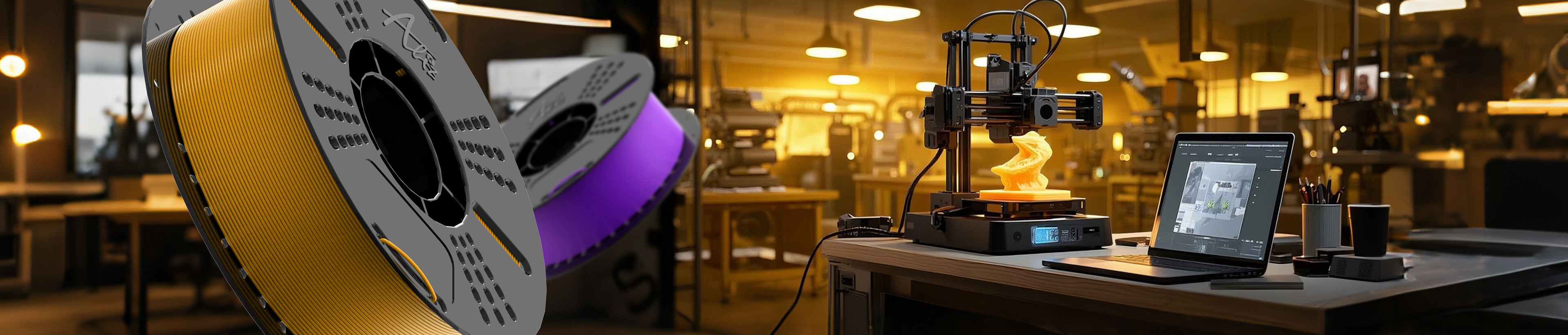
Buyers who supply makers, print farms, and consumer brands want filament that looks premium and prints without trouble. PETG Metallic & Galaxy filament delivers both. It pairs the toughness of PETG with a shimmering metal or glitter finish, so decorative parts look polished straight off the build plate.
This guide is written for importers, distributors, wholesalers, and OEM/ODM brand owners who compare suppliers before sending an inquiry. It explains what the material is, how the two finishes differ, which specifications to check, and how to print and store it. It also covers custom colors, private label options, and the questions to settle before a bulk order.
Aliz is the 3D printing filament brand of Jiangyin Longshan Synthetic Materials Co., Ltd. Longshan develops and produces modified plastic pellets, and Aliz focuses exclusively on 3D printing consumables. That background in polymer formulation shapes how we make 1.75mm PETG filament for global buyers.
What Is PETG Metallic & Galaxy Filament?

PETG is a glycol-modified polyester widely used in FDM 3D printing. It prints more easily than many engineering plastics and offers better toughness and layer bonding than standard PLA. That balance is why PETG has become a core product for distributors and online filament shops.
PETG Metallic & Galaxy filament builds on that base and adds a visual effect. The metallic series uses a metallic luster formula that gives prints a fine metal-like reflection and a high-gloss finish. The galaxy series adds fine reflective particles that create a sparkling, star-field look. Both finishes keep the practical strengths of PETG, so they suit decorative parts and light functional parts alike.
PETG Metallic & Galaxy Filament Key Features
Buyers usually ask three questions: how does it look, how does it perform, and how reliably does it print? The main features answer all three.
•
Metallic appearance: A fine metallic reflection and high-gloss surface remove the cheap plastic look of ordinary filament. Layer lines look subdued, and parts are presentable straight off the build plate.
•
PETG base properties: The material keeps PETG's toughness and strong interlayer adhesion. It is more durable than standard PLA, which makes it suitable for enclosures and structural parts.
•
Stable printing experience: An optimized formula reduces stringing and nozzle clogging. It works with mainstream FDM printers and multi-spool AMS systems.
•
Less post-processing: A finished-looking surface means your customers spend less time sanding, painting, or polishing display parts.
PETG Metallic vs. PETG Galaxy: What's the Difference?
PETG Metallic
The metallic series is built for a smooth, premium, metal-like surface. Colors such as silver, gold, and bronze make printed parts look like machined or cast items. It is a strong choice for display models, product prototypes, trophies, and household decor.
PETG Galaxy
The galaxy series is built for depth and sparkle. Fine particles catch the light and change the look of a part from different angles. It sells well for cosplay props, toys, figurines, and gift items.
Quick comparison
•
Look: Metallic gives a uniform, brushed-metal feel. Galaxy gives a glittering, multi-point sparkle.
•
Best for: Metallic suits clean, premium display parts. Galaxy suits eye-catching creative items.
•
Printing: Both use a PETG base and follow similar settings. Galaxy parts may show more surface sparkle on large flat faces, so test a sample print first.
Technical Specifications: 1.75mm and 2.85mm Diameter, 1kg and 3kg Spools
The table below summarizes the core specifications and what importers should confirm before ordering.
| Item |
Details |
What buyers should confirm |
| Base material |
PETG |
Datasheet and print profile |
| Finishes |
Metallic and Galaxy |
Current color card and samples |
| Diameter |
1.75mm / 2.85mm |
Which size your market needs |
| Spool weight |
1kg / 3kg per roll |
Spool type for your printers |
| Printer compatibility |
Mainstream FDM printers, multi-spool AMS systems |
Spool size fit for AMS units |
| Customization |
OEM/ODM colors, formulation, spools, packaging |
Brief, sample approval, artwork |
The 1.75mm diameter is the most common size for desktop FDM printers, so it is the usual choice for retail and distribution. The 2.85mm diameter serves a smaller group of printers that need thicker filament. Check which size your market uses most before you build stock.
For spool weight, 1kg rolls suit retail shelves and individual users. The 3kg rolls suit print farms and workshops because they reduce spool changes during long jobs. Many buyers stock both.
Available Metallic and Galaxy Colors
Metallic shades in the market commonly include silver, gold, bronze, copper, and dark graphite tones. Galaxy shades usually pair deep base colors, such as purple, blue, green, and black, with visible glitter.
The current color card can change as new shades are added. Ask the Aliz team for the latest range and color samples before you plan your catalog. If you need a specific shade for your brand, see the custom color options in the OEM/ODM section below.
Recommended Print Settings (Nozzle, Bed, Speed)

Settings vary by printer, so treat the ranges below as typical starting points for PETG. Always check the product datasheet and run a short test print.
•
Nozzle temperature: About 230–250 °C.
•
Bed temperature: About 70–85 °C. A clean, level bed improves first-layer adhesion.
•
Print speed: Start at 40–60 mm/s, then increase once the surface looks clean.
•
Cooling fan: Use moderate cooling. Too much airflow can weaken layer bonding.
•
Retraction: Keep retraction short and tune it to reduce stringing.
•
Nozzle size: Use 0.4mm or larger.
Your end users will often copy these values into their slicer profiles, so clear print guidance in your product listing can reduce support questions.
Will Galaxy Glitter and Metallic Particles Clog the Nozzle?
Short answer: not under normal conditions. The Aliz formula is optimized to reduce stringing and nozzle clogging, and a 0.4mm or larger nozzle is the recommended minimum. For long prints or very detailed models, a 0.6mm nozzle adds extra margin.
Most clogs come from print conditions, not from the filament itself. These habits prevent most problems:
• Keep the filament dry before and during printing.
• Avoid nozzles smaller than 0.4mm.
• Hold a steady nozzle temperature and avoid overheating.
• Clean the nozzle or run a cold pull if flow becomes uneven.
Compatible 3D Printers and AMS Multi-Spool Systems
PETG Metallic & Galaxy filament is designed for all mainstream FDM printers. It also works with AMS multi-spool systems, which matters for buyers who sell to users of multi-color printers.
One practical point: multi-spool systems usually work with standard 1kg spools. Larger 3kg spools often fit open spool holders better, so they suit print farms more than AMS users. State this in your product listings to avoid mismatched orders.
Applications: Decorative Models, Cosplay, Props and Functional Enclosures
The finish and the PETG base let one product serve several markets:
•
Decorative models and display pieces: Figurines, vases, trophies, and desk items with a premium look.
•
Cosplay and props: Armor parts, helmets, and accessories that need shine and durability.
•
Functional enclosures: Housings and covers where appearance matters as much as toughness.
•
Structural parts: Brackets, holders, and light-duty mechanical parts that need more durability than standard PLA.
•
Retail and gift products: Printed consumer goods sold by makers and small brands.
PETG Metallic & Galaxy vs. PLA Metallic: Strength and Durability Compared
Many buyers stock both materials, so it helps to explain the difference clearly to end users.
•
Toughness: PETG resists impact better and is less brittle than PLA. PLA is stiffer but can crack under sudden load.
•
Layer adhesion: PETG bonds strongly between layers, which helps with functional parts.
•
Heat resistance: PETG generally tolerates higher temperatures than PLA, so it is safer for parts near warm environments.
•
Ease of printing: PLA usually prints at lower temperatures and shows sharper fine detail. PETG needs slightly higher temperatures and good moisture control.
•
Finish: Both can look metallic, but PETG parts combine the finish with greater durability.
In short, choose PLA Metallic for display-only pieces. Choose
PETG Metallic & Galaxy when the part must look good and last.
How to Dry and Store PETG Filament
PETG absorbs moisture from the air. Wet filament causes stringing, bubbling, popping sounds, and a dull surface, which hides the metallic or glitter effect. Good storage protects both print quality and your customer reviews.
•
Drying: A common range is 60–65 °C for 4–6 hours in a filament dryer or dry box.
•
Storage: Keep spools in sealed bags or airtight boxes with desiccant.
•
After opening: Return unused spools to storage promptly.
•
For distributors: Keep stock in a dry warehouse and rotate older stock first.
When you request a quotation, ask about vacuum packaging and desiccant so spools arrive ready to print.
OEM/ODM Custom Colors and Private Label Filament
Many buyers want their own brand, not just a standard product. Our OEM/ODM service covers customized formulations, color matching, personalized spools, and packaging, so you can launch a private label metallic or galaxy line.
A typical custom project follows these steps:
• Share your target color, reference sample, or color code.
• Choose diameter and spool weight, such as 1.75mm on 1kg spools.
• Review and approve a sample.
• Confirm spool design, label, and packaging artwork.
• Place the bulk order and plan shipment.
Learn more about our
OEM/ODM service or send your brief through the contact page.
Why Choose Aliz (Longshan) as Your PETG Filament Manufacturer?

Longshan brings more than 25 years of experience in modified plastics, and Aliz applies that knowledge exclusively to 3D printing filament. Our range covers PLA, PETG, PA, ABS/ASA, TPU, and PPS, so you can source several materials from one supplier. You can browse the full
PETG filament range on our website.
If your customers also need reinforced material, see our
PETG-CF filament supplier page for carbon fiber PETG options.
Supplier selection tips for buyers
• Request a technical datasheet and compare it with the sample you receive.
• Test a sample on your own printers before placing a large order.
• Check spool winding quality, label clarity, and packaging protection.
• Confirm color consistency between batches, especially for metallic and galaxy shades.
• Choose a supplier that answers technical questions quickly and clearly.
Bulk Orders, MOQ, Packaging and Shipping
Order terms depend on color, diameter, spool type, and packaging, so we confirm them project by project. To get an accurate quotation quickly, send these details:
• Product:
PETG Metallic & Galaxy filament, with preferred colors.
• Diameter and spool weight: 1.75mm or 2.85mm, 1kg or 3kg.
• Estimated order quantity and target market.
• Packaging needs: neutral packing or your own brand design.
• Destination port or country.
Ask for samples first if you are evaluating a new supplier. Sample testing helps confirm print quality, color, and packaging before you commit to volume.
PETG Metallic & Galaxy Filament FAQs
What is PETG Metallic & Galaxy filament?
It is PETG filament with a metallic or glitter finish. It combines PETG's toughness and layer adhesion with a premium, shimmering appearance.
Which diameters and spool weights are available?
The product page lists 1.75mm and 2.85mm diameters, with 1kg and 3kg rolls.
Will the metallic or galaxy particles clog my nozzle?
Normally no. The formula is optimized to reduce clogging and stringing. Use a 0.4mm or larger nozzle, keep the filament dry, and hold a steady temperature.
Can I order custom colors or private label packaging?
Yes. Our OEM/ODM service supports custom formulations, colors, spools, and packaging. Share your color reference and quantity to start.
Do I need to dry this filament before printing?
PETG absorbs moisture, so drying helps when you see stringing, bubbles, or a dull surface. A common range is 60–65 °C for 4–6 hours. Store spools in sealed bags with desiccant.
How do I request samples or a quotation?
Send your target colors, diameter, spool weight, quantity, and destination through the contact page. Our team will reply with product details and next steps.
Conclusion
PETG Metallic & Galaxy filament gives your customers a premium look with the strength and reliability of PETG. For importers, distributors, and brand owners, it is a practical way to add a higher-value product to a filament range, whether you sell standard spools or a private label line.
Aliz combines polymer know-how from Longshan with a dedicated 3D filament focus, flexible OEM/ODM options, and 1.75mm and 2.85mm formats. If you would like product details, samples, a quotation, or technical support,
contact our team. We are happy to help you plan the right specification for your market.