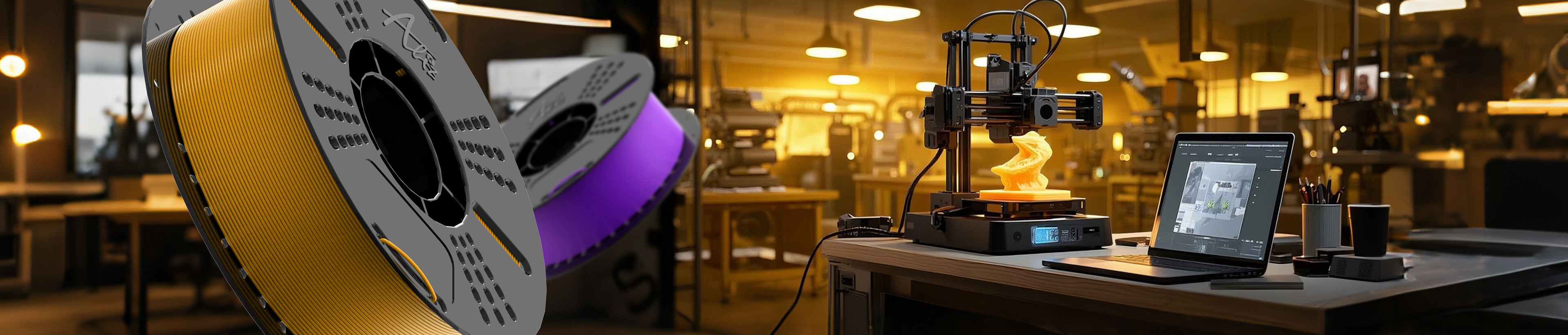
Outdoor 3D printed parts often fail for one reason: the material cannot handle sun, rain and heat. Standard filaments fade, crack or soften. ASA 3D printing filament solves this problem. It prints much like ABS, but it keeps its color and strength far better under UV light and harsh weather.
ALIZ ASA filament comes in 1.75mm and 2.85mm diameters, on 1kg and 3kg spools, in six colors. This guide is written for importers, distributors, brand owners and procurement teams. It explains what the material is, how it performs, how to print it, and what to check before you place an order. All technical figures come from ALIZ product data.
ASA 3D Printing Filament 1.75mm and 2.85mm – Product Overview

ALIZ is the 3D printing brand of Jiangyin Longshan Synthetic Material Co., Ltd. Longshan develops and produces modified plastic pellets. ALIZ is its subsidiary and focuses only on 3D printing consumables. The filament line therefore draws on the parent company's material science and testing resources.
Here is the product at a glance:
•
Material: ASA (acrylonitrile styrene acrylate)
•
Diameters: 1.75mm and 2.85mm
•
Spool weight: 1kg and 3kg
•
Colors: black, white, gray, red, blue and green
•
Core strengths: UV, weather, heat, water and chemical resistance
•
Supply options: OEM/ODM, custom colors, private label and bulk orders
What Is ASA 3D Printing Filament?
ASA is a ternary copolymer made from acrylonitrile, styrene and acrylic rubber. It keeps the main strengths of ABS, such as toughness and good mechanical properties. The acrylic rubber adds the weather resistance that ABS lacks.
In simple terms, ABS works well indoors, while
ASA filament suits parts that sit in sunlight, wind and rain. The material resists aging, fading and brittleness. It also has a good melt flow, which helps the filament extrude smoothly and gives a cleaner surface finish.
Key Features of ALIZ ASA Filament: UV, Weather and Heat Resistance
•
UV and weather resistance. Parts resist fading and brittleness during long outdoor exposure.
•
Heat resistance. ASA handles higher temperatures than many general-purpose filaments. Its glass transition temperature is 114.2°C.
•
Water resistance. Parts stay stable in damp and wet conditions, including rain.
•
Chemical resistance. The material resists weak acids, weak bases, oils and grease.
•
Anti-static behavior. This reduces dust build-up on part surfaces.
•
Good flowability. The melt flow index is 15–25 g/10 min (220°C, 10kg).
•
Acetone solubility. You can bond and smooth parts with acetone.
ASA Filament Specifications: 1.75mm/2.85mm, 1kg/3kg Spools
Buyers usually compare diameter, spool size, colors and basic material data first. This table summarizes them.
| Item |
ALIZ ASA Filament |
| Material |
ASA (acrylonitrile styrene acrylate) |
| Diameter |
1.75mm / 2.85mm |
| Spool weight |
1kg / 3kg |
| Colors |
Black, white, gray, red, blue, green |
| Density |
1.05 g/cm³ (ISO 1183) |
| Melt flow index |
15–25 g/10 min (220°C, 10kg, ISO 1133) |
| Moisture absorption |
0.6% for 3D printed samples (50% RH, 23°C, ISO 62) |
| Recommended nozzle temperature |
260–280°C |
| Recommended bed temperature |
90–100°C |
The 1.75mm size fits most desktop and professional printers. The 2.85mm size suits printers built for thicker filament. The 3kg spool works well for print farms and high-volume users, while the 1kg spool suits retail stock and trial orders. If you need diameter tolerance data or batch test reports, ask our team before you order.
Available ASA Filament Colors
ALIZ offers
ASA filament 1.75mm and 2.85mm in six standard colors: black, white, gray, red, blue and green. Black, white and gray suit functional and industrial parts. Red, blue and green suit branded or highly visible components.
Need a different shade? Custom colors and color matching are available through our OEM/ODM service, described below.
Recommended ASA Filament Printing Settings (Nozzle, Bed, Speed)
The table shows our recommended settings for a 0.4mm nozzle, plus the settings used in our own tests on a Bambu Lab P1S printer.
| Parameter |
Recommended |
Test setting (P1S) |
| Printing temperature |
260–280°C |
270°C |
| Bed temperature |
90–100°C |
90°C |
| Wall layers |
2 |
2 |
| Top and bottom layers |
4 |
4 |
| Infill |
100% |
100% |
| Ambient temperature |
25°C |
25°C |
| Cooling fan |
0–10% |
10% |
| Printing speed |
30–50 mm/s |
50 mm/s |
| Nozzle diameter |
0.4mm |
0.4mm |
Settings change with nozzle size and printer model. Test specimens rested at room temperature for 24 hours before testing.
Is ASA Filament Good for Outdoor Use?
Yes. Outdoor use is the main reason buyers choose ASA. The material handles three things that damage other filaments:
•
Sunlight: high UV resistance limits fading and cracking.
•
Rain and moisture: parts keep their properties in wet conditions.
•
Wind and weathering: surfaces age more slowly than standard ABS.
Buyers in regions with strong sunlight, such as the Middle East, Australia, and parts of Africa and Latin America, often prefer ASA for this reason.
Know the limits
Good buyer advice includes honest limits. Keep these points in mind:
• Printed parts have a heat deflection temperature of about 86.6°C (X-Y) and 80.3°C (Z) at 0.45 MPa. Do not use them for continuous load near these temperatures.
• Z-axis strength is lower than X-Y strength. Orient parts so layers are not pulled apart.
• ASA does not resist organic solvents. Avoid contact with them.
ASA vs ABS Filament: Which Is Better for 3D Printing?
ASA and ABS share a similar structure, so they print in a similar way. The main difference is the rubber phase: ABS uses butadiene rubber, while ASA uses acrylic rubber. That change gives ASA its outdoor durability.
•
Outdoor use: ASA is the stronger choice. Its aging resistance is far better than ABS.
•
Indoor parts and tight budgets: ABS is often enough and usually costs less.
•
Printing needs: both materials need a heated bed and benefit from an enclosed printer.
•
Post-processing: both can be smoothed and bonded with acetone.
For buyers, the answer depends on your customers. Stock ASA for outdoor, long-life and functional parts. If your market mostly prints indoor prototypes at a lower price, our
ABS filament may fit better. Many distributors carry both.
ASA 3D Printing Filament Mechanical and Thermal Properties
The table compares injection molded samples with 3D printed samples in two directions. X-Y is along the layers, and Z is across them.
| Property (unit) |
Injection molded |
3D printed X-Y |
3D printed Z |
| Tensile strength (MPa) |
45.1 |
35.9 ± 3 |
21 ± 2 |
| Elongation at break (%) |
14.6 |
6.5 ± 1 |
1.4 ± 0.3 |
| Tensile modulus (MPa) |
2003.1 |
1839.2 ± 100 |
1608.2 ± 100 |
| Flexural strength (MPa) |
69.6 |
56.3 ± 4 |
28.3 ± 2 |
| Flexural modulus (MPa) |
2203.3 |
1950 ± 100 |
1470 ± 100 |
| Charpy impact (kJ/m²) |
61.6 |
27.9 ± 2 |
5.5 ± 1 |
| Heat deflection, 0.45 MPa (°C) |
98.3 |
86.6 |
80.3 |
| Heat deflection, 1.8 MPa (°C) |
85 |
77.8 |
75.7 |
| Vicat softening (°C) |
107.5 |
98.7 |
98 |
Test methods: ISO 527 (tensile), ISO 178 (flexural), ISO 179 (Charpy), ISO 75 (heat deflection), ISO 306 (Vicat).Printed parts are strongest along X-Y. Engineers should design load paths with this in mind, especially for brackets, housings and clips.
Applications of ASA Filament: Automotive, Garden, Electronics and More
•
Automotive: exterior mirrors, rear spoilers, lamp covers and motorcycle panels.
•
Horticulture: garden irrigation equipment and lawn mower housings.
•
Electronics and appliances: all-weather enclosures and equipment housings.
•
Consumer goods: outdoor equipment and durable display components.
•
Architectural models: models that face outdoor conditions or need a smooth, paintable finish.
•
Sports and marine: surfboard parts and other exterior components.
These uses give distributors and brand owners clear selling points for outdoor and industrial customers.
How to Print ASA Filament Without Warping
Warping is the most common ASA problem. It happens when layers cool unevenly. These steps help:
1.
Heat the bed to 90–100°C. A hot bed keeps the first layers attached.
2.
Control the air. Print in an enclosure or a draft-free room.
3.
Keep the fan low. Use 0–10% cooling.
4.
Print slowly. A speed of 30–50 mm/s gives better layer bonding.
5.
Prepare the bed. Clean it well. Add a brim for large, flat parts.
6.
Keep filament dry. Store spools sealed with desiccant. Wet filament causes bubbles and rough surfaces.
Also print in a ventilated space. Heated ASA releases fumes, and good airflow protects the operator.
How to Smooth ASA Prints with Acetone
ASA dissolves in acetone. This lets you bond separate parts and smooth layer lines.
•
Bonding: apply a small amount of acetone to both surfaces, press them together and let them cure.
•
Smoothing: apply acetone lightly to the surface, or use a controlled vapor method.
•
Safety: acetone is flammable. Work in a ventilated area, away from flames and heat, and wear gloves.
•
Testing: try the method on a scrap print first. Over-smoothing can soften details and change dimensions.
Why Choose ALIZ as Your ASA 3D Printing Filament Manufacturer

Choosing an
ASA filament manufacturer is about consistency as much as price. Here is what supports the ALIZ line:
•
Material science background. Longshan has long experience in modified plastics and operates an independent CNAS laboratory.
•
Production equipment. Longshan runs automatic production lines with equipment imported from Germany and Japan, including loss-in-weight feeders and twin screw extruders.
•
In-house testing. Test equipment covers mechanical, thermal, melt flow and UV aging tests.
•
Quality system. Longshan lists ISO9001, ISO14001, IATF16949 and UL qualifications.
•
Customer base. Longshan reports serving more than 900 industrial enterprises across Asia, Europe and North America.
You can review the equipment and testing details on our
Why Choose Us page.
Supplier checklist for ASA filament buyers
Before you choose any supplier, ask for these items in writing:
• A technical data sheet and recent test results
• Diameter tolerance and batch consistency information
• Moisture-protective packaging details
• Color matching ability for repeat orders
• Minimum order quantity, lead time and payment terms
• Technical support after delivery
ASA Filament OEM/ODM, Bulk and Wholesale Orders
Importers, distributors, wholesalers and brand owners in North America, Europe, the Middle East, Asia-Pacific, South America and Africa can build their own ASA product line with ALIZ. Our
OEM/ODM service covers:
• Custom filament formulation for specific performance needs
• Custom colors, finishes and color matching
• Private labeling and toll manufacturing
• Custom packaging and labeling, including branded spools and boxes
• Prototype and small-batch runs for testing before full production
• Material selection advice and technical support
Minimum order quantity, lead time and shipping terms depend on color, packaging and destination. We confirm them in your quotation. A simple way to start:
1. Send your required diameter, spool weight, colors and quantity.
2. Share your destination market and packaging needs.
3. Receive product information and a quotation. We aim to reply within 24 hours.
4. Test a prototype or small batch if you need to.
5. Confirm the order and production plan.
ASA 3D Printing Filament FAQ
1. What is ASA filament used for?
ASA filament is used for parts that face sunlight, rain and wind. Common examples include automotive exterior parts, garden equipment, outdoor enclosures and architectural models.
2. What temperature do I need to print ASA?
We recommend a nozzle temperature of 260–280°C and a bed temperature of 90–100°C for a 0.4mm nozzle. Keep the cooling fan between 0% and 10%.
3. Is ASA better than ABS?
For outdoor use, yes. ASA resists UV light and weathering much better. For indoor parts on a tight budget, ABS can be enough.
4. Do I need an enclosure to print ASA?
An enclosure is not always required, but it helps. It reduces drafts and uneven cooling, which lowers the risk of warping, especially on large parts.
5. What sizes and colors do you offer?
We offer 1.75mm and 2.85mm diameters, 1kg and 3kg spools, and six colors: black, white, gray, red, blue and green. Other colors can be discussed through OEM/ODM.
6. Can I order private-label ASA filament?
Yes. ALIZ supports private labeling, custom packaging, custom colors and small-batch prototype runs. Contact us with your requirements for a quotation.
Conclusion
ASA 3D printing filament gives buyers a practical answer to outdoor printing. ALIZ ASA filament offers UV, weather and heat resistance in 1.75mm and 2.85mm diameters, with 1kg and 3kg spools in six colors. The published test data helps your engineers and customers set clear expectations. OEM/ODM support helps you build your own brand.
If you are comparing suppliers, we welcome your questions.
Contact Us for product details, a quotation, custom colors, samples or technical support. Our team will help you choose the right specification for your market.